
I love a good mystery. A whodunit where the tension builds up as the clues keep us guessing…until we discover, gasp! that the spurned lover did it, or the creepy Butler did it, or the shy, nerdy neighborhood psychopath did it. But aside from those kind of solvable mysteries, I have always been fascinated by the secret stories that infuse objects with a life of their own. You may know the history of those treasured items you inherited, such as Aunt Mary’s Wedgwood tea set, or you may not. I have many trinkets and such in my home that are elusive mysteries to me. It is fun to think about the forgotten stories that resonate with these objets d’art. In museum speak, the word is “provenance” which means the ownership history of an artwork — from its very creation to its path to a specific collection.
Many years ago, as a hobby, I regularly visited estate sales with my daughter. We enjoyed it so much we started accumulating a lot of “stuff” and eventually rented out a little nook in an antique store. We christened our musty, cluttered corner, “Betsy’s Basement.” My daughter, the aforementioned Betsy, even painted the sign for it. We had so much fun finding odds and ends and all the while making very little money doing it. After giving it a go for about a year or so, it became too much for me as a single mom to manage this side business, work full time and maintain our home. I sold most of our inventory, but have a few choice remnants from our endeavor scattered hither and yon around my home.
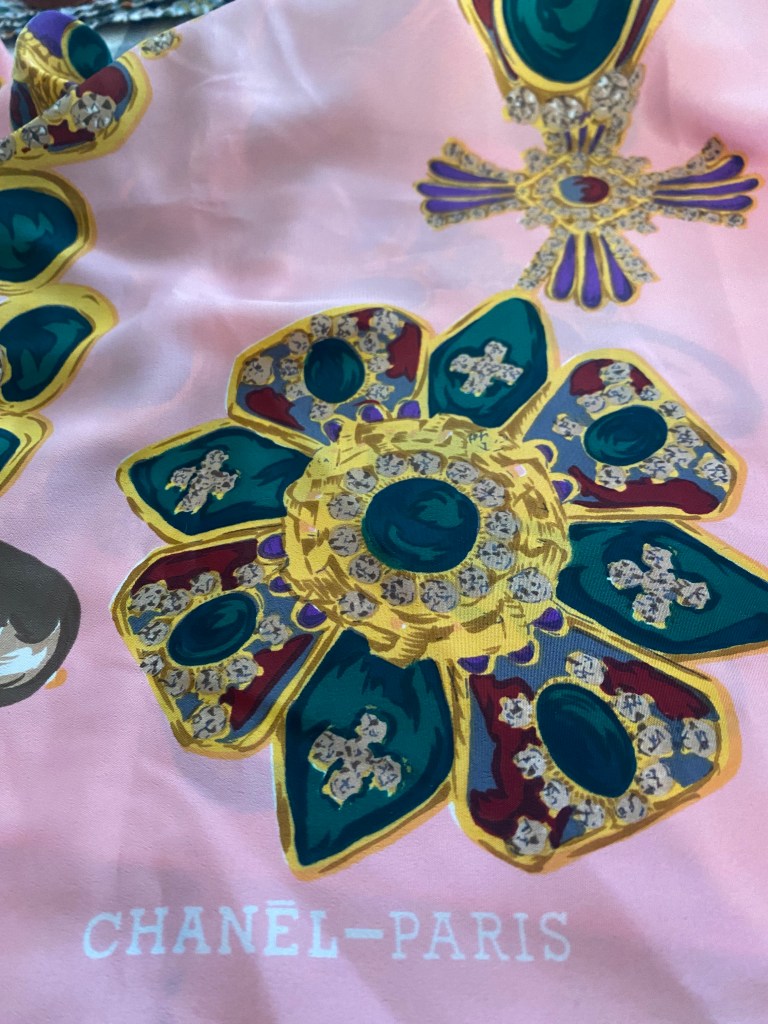
In the meantime, the estate sales were truly fascinating and eye opening. Some of these sales were more interesting (and disturbing) than others. One such sale in particular stands out for me. A woman, who I believe had been from Germany, passed away and left quite a treasure trove. Everything in her large hillside Hollywood home was up for grabs. Her clothes were in excellent condition, beautiful and from well known designers. Women were going crazy looking at everything…there was quite the buzz in the air as everyone searched for a great deal. I snatched up a Chanel scarf.
Why did I believe she was German, you may ask? Most of her belongings were European and her books were primarily in German, so this is my own hypothesis. Her book collection included — get ready for it — a copy of the infamous Mein Kampf — Hitler’s autobiographical manifesto that spelled out his racist, Antisemitic and political ideology. Well, I’m Jewish. When I saw that book, I was shocked. I had a physical reaction of both intense anger and sadness. The book, which carries with it such a tumultuous history of sorrow, was lying on a table with a lot of other books in a nonchalant manner. Was this deceased woman a former member of the Nazi party? Maybe she had been a Professor of European History and the book was part of her curriculum? Giving her the benefit of the doubt, she was probably a little girl at the time of WWII, I’m guessing. I’ll never know.

Speaking of books, and changing the subject, (whew!) my all-time favorite book that is in my collection is Poems of To-day, only the “today” in the title refers to 1915. My copy is from 1918; the book had a few printings back in the day. To make it even more glamorous, I bought the book over 30 years ago at one of the most famous bookstores in the world, Shakespeare and Company in Paris. I think I spent hours in that store; and it is right across the street from Notre Dame and the Seine so the location is tres magnifique.

If you know your history, then, this book was published in the midst of World War I which went from July 1914-November 1918. The book was published in England and states in a preface that “Naturally, there are some poems directly inspired by the present war, but nothing, it is hoped, which may not, in happier days, bear translation into any European tongue.” The goal, then, of the publishers was to showcase modern poetry and hope that it would stand the test of time beyond wartime.
Some notable poets in this collection include Mary Coleridge, Rudyard Kipling, Robert Lewis Stevenson and William Butler Yeats. Quite the line up! There are many poets whose names I don’t recognize. But their words live on, nonetheless.
When I hold this fragile, yellowing book in my trembling hands, I imagine the gentle hands of others who turned the pages before me. Perhaps a school teacher in the Cotswolds? Or a London mother reading to her children before bedtime…or maybe, just maybe, a student at Oxford read it before having to go off to war. Maybe the above referenced student went to war in France, brought the book as solace as he suffered through the abominable trenches, and later he ended up in Paris! My imagination has run wild. Somehow, the book found its way from England to France, that is a fact. How it got there, is the mystery. Now the book has crossed the Atlantic and resides in a modest suburban home in Santa Clarita, California.
If you are so inclined, you can access a copy of this remarkable poetic tome courtesy of Archive.org.
While working on this blog, I started going down a rabbit hole of unfathomable depths and found another website full of WWI poetry, for anyone amongst us who may be interested:
https://www.poetryfoundation.org/articles/70139/the-poetry-of-world-war-i
What objects do you have that are particularly evocative? Something you inherited, or something you discovered in a dusty, spider webby corner of an antique store on a rainy Autumn day? I’d love to hear from all of my loyal readers out there! Meanwhile, I’m wishing everyone a very happy Autumnal Equinox which officially begins on Friday, September 22 at 11:50 pm Pacific Time. I’ve just bought some pumpkin blondie bars from Whole Foods to celebrate the season. It is no mystery that pumpkin, sugar and flour are a great combination!

 Cheryl Thatt-Burbank