
Have any of my loyal readers seen Apple TV’s Masters of the Air? If you haven’t, I would highly recommend. First off, it’s must see TV for history buffs, and secondly, and more importantly, it shows the dangerous missions of the bomber squadrons that fought valiantly during WWII. The focus of the TV series (based on the book by Donald L. Miller) is on the Mighty Eighth Air Force of the United States and in particular, the 100th bomber squad, also known as the “The Bloody Hundredth” because of the great loss of life this squadron encountered. It is mind boggling what these men endured as they flew deep into Nazi Germany airspace. It is a companion piece to Band of Brothers and The Pacific all produced by Steven Spielberg, Tom Hanks and Gary Goetzman, amongst others. I know I sound like a commercial here, but watching this show was very emotional for the obvious reasons and in part because of a story that has been unfolding in my personal life.
Let’s back track a bit.
A month or so ago I started reading Flyboys by James Bradley about “the harrowing true story of nine American airmen shot down in the Pacific…” I love non-fiction, and had just barely started reading it, when a sentence on page five hit me like a lightening bolt: “Over the decades, relatives of the airmen wrote letters and even traveled to Washington, D.C. in search of the truth.” Sometimes you get a feeling in the pit of your stomach, and after reading this passage in the book, I had that feeling.
Now I need to back track even more.
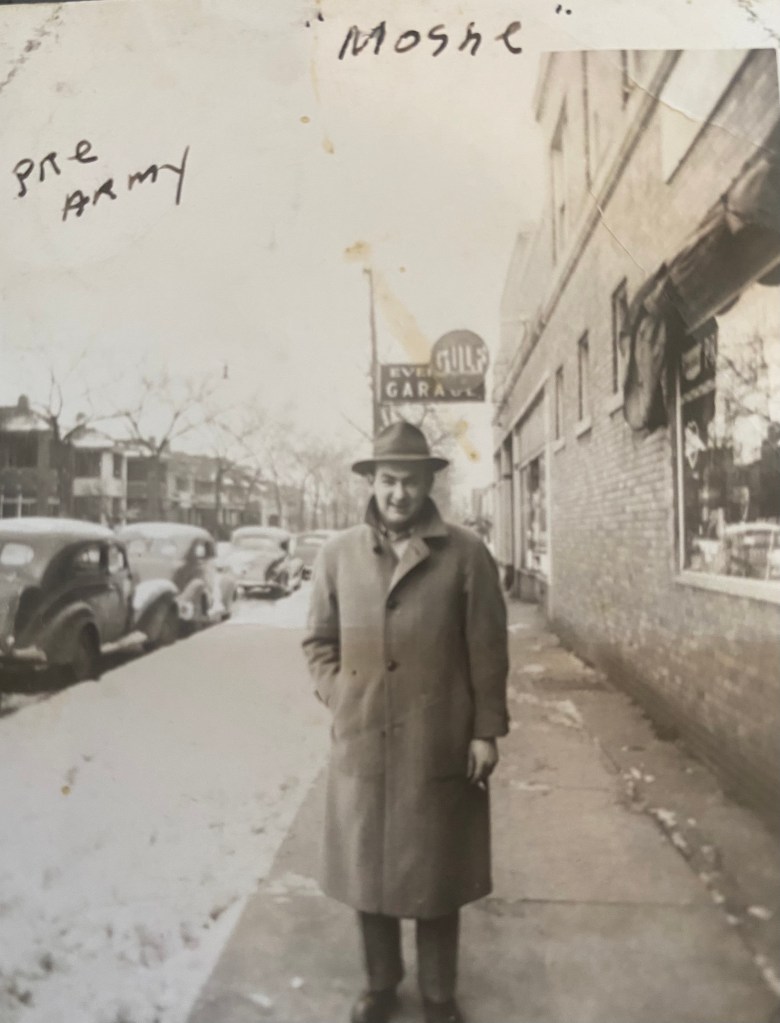
My mother, RIP, had told me many, many years ago about her brother, Moshe, pictured above, who had been part of a WWII air crew whose plane disappeared over the Atlantic. The plane, and all of its crew, were officially ruled as KIA, Killed in Action. After learning about her brother’s death, my mom had traveled to Washington D.C. to find out more about the circumstances of Moshe’s fate, but to no avail. Apparently there was some sort of mystery surrounding the plane’s demise. But time passed. My mom passed away over 20 years ago and I forgot about my Uncle Moshe’s tragic story. The circumstances of his death went as cold as the Atlantic waters where he perished over 80 years ago.
After I read the sentence in Flyboys, however, a little internal voice spoke out to me, “You need to find out more about your uncle. You need to do this.” And so began my journey.
As a start, I tried Googling his name and I got nothing. Next, I texted my older brother (thank goodness for older brothers!) and asked him about our uncle. “All I know is his name is Morris or Mortimer and he was flying on a B-17…mom or dad never discussed this with me…” So now I had another name to look up. Moshe could have been his Hebrew name, or a nickname. When I researched “Morris Meyers, WWII” this instantly came up:

Now here was some tangible information I could work with! I had never known about this Memorial in New York City and now vow to visit it. Here is a description of the East Coast Memorial from their website:
“The World War II East Coast Memorial is located in Battery Park, New York City. This memorial commemorates those soldiers, sailors, Marines, coast guardsmen, merchant mariners and airmen who met their deaths in the service of their country in the western waters of the Atlantic Ocean during World War II. Its axis is oriented on the Statue of Liberty. On each side of the axis are four gray granite pylons upon which are inscribed the name, rank, organization, and state of each of the over 4,600 missing in the waters of the Atlantic. For names where an individual’s remains have subsequently been accounted for by the U.S. Department of Defense, a rosette is placed next to the name on the memorial to indicate that the person now rests in a known gravesite.”
When I learned this information, both that there was an actual record of him, and that his name was etched in granite facing the Statue of Liberty, I became very emotional and even more invested in learning more. I couldn’t believe that I had lived and visited NYC and never knew the Memorial was there!
Next I found out that there was a Facebook page for those people who had family members or a connection to the 385th Bomb Group, of which my uncle had belonged. (Thank goodness for Facebook!) I went on their page, asked if anyone could help me find out more information, and BOOM, the President of the group, Shannon Muchow, messaged me right away, literally within minutes. I will always be indebted to her kindness in that regard. Shannon, who coincidentally lives nearby, also invited me and my husband for dinner that weekend with others in the group for a Masters of the Air viewing party and dinner. YES! YES! YES! (We had a wonderful time, too, by the way. A lovely group of people!)
This same 385th group also published a book which details ALL of the squadron’s missions and has pictures of the crews. What a treasure trove of information! As I had also discovered the official date of my uncle’s disappearance, that was a great help. Shannon sent me excerpts from the book and I was able to piece together what happened a little more clearly.

From the book, I learned that a B-17 flight left Gander airport in Newfoundland (I remember my mom mentioning Newfoundland!) at 2142 hours on June 20, 1943 en route to Prestwick, Scotland. According to the book, “Last radio contact with Gander was 2208 hours. Contact was made with Prestwick at 0904 hours on June 21st, so they got very close, but nothing further was heard and all were considered lost and KIA.” Also mentioned was the pilot’s name, H.F. Powley and the plane’s serial number.
Here is a picture of Powley’s crew:

If you are a novice investigator such as myself, you would now wonder, is my Uncle Morris in this picture? There are no names with this picture, other than the pilot, Herbert F. Powley. Studying the picture closely, I believe my uncle is standing on the far right. All I have to go by is the one picture I have of him from his pre-Army days.
Sigh. I hope I haven’t lost you because there is MORE.
I also was curious to find out the reason my mom went to Washington D.C. to investigate her brother’s death. I started to reach out to various government agencies. The National Personnel Records Center wrote back to me and informed me that many Army records from 1912-1959 were destroyed in a fire on July 12, 1973. They referred me to two other agencies, of which I have not yet contacted.
The other night, however, I was just casually scrolling around on the National Archives website and lo and behold I found out something very interesting. Since I knew the serial number of my uncle’s plane (again from the INCREDIBLE 385th book!) I was able to connect some more research dots. Apparently, another flight disappeared that evening from another bomb group. The father of the other plane’s pilot corresponded with Army intelligence as to the loss of his son’s plane, as well as the plane my uncle was on. All of this correspondence, which went on for a period of over two years, was labeled “SECRET” across the top. Not so secret, anymore, however.
This father really laid into the Army powers that be over the disappearance of those two planes. This may have been why my mother went to Washington, D.C., as well. Here is an excerpt from one of his powerful letters…

One of many letters written to try and uncover what happened to two planes flying across the Atlantic Ocean on June 20, 1943.
In summation, this father states that both planes left within a half an hour of each other. He found out that the weather report on that day indicated SEVERE ICING CONDITIONS, and the men should not have been ordered to fly in those conditions. (Those planes did not have heaters, by the way, so air crew had to really bundle up in those altitudes.) He also states that the planes should have been in contact with a base every hour, which they were not. He is angry because he feels that “those responsible for their immediate dispatch across the sea, were either incompetent…or [were negligent].” He also implies in other correspondence that when the planes did not arrive, a search party was not dispatched in a timely manner.
Whether or not it was severe icing, or negligence, or plane malfunction, we will never know. Reading these letters written by a grieving father and how he was trying to understand and make sense of his son’s fate, as well as the fate of both crews, was heart wrenching. Most likely other families reached out, too. I found another website of a private historian who delves into the war stories of Michigan veterans. He mentions my uncle and that there was a “letter” written to Army headquarters. I emailed him, but have not heard back yet.
My Uncle Morris’ mystery is solved, sort of. Questions still remain and I will continue to search and find out as much as I can. I am on my own mission, so to speak. Staff Sargent Morris Meyers received a Purple Heart for his service, too, and I have no idea if that still exists. I messaged a maternal cousin, but have not heard back from her yet. My family left our Detroit, Michigan roots in 1962 for a new life in sunny California and lost many connections along the way.
The reality is that if you served in the military in WWII you were in harm’s way. Still true today! As I mentioned earlier, I love non-fiction and have read books such as Unbroken, Ghost Soldiers, With the Old Breed, and many more. Those accounts of sacrifice and bravery of “The Greatest Generation” need to be kept alive, as it is too easy to take our imperfect, yet cushy lives for granted. Estimates of casualties in WWII run from 70-85 million people (both military and civilian). I’m sure my readers all know loved ones who served their country in one way or another, too.
The haunting stories of these veterans’ survival instincts continue to teach humility, resilience and how to cope in difficult times. I have turned to these touchstone tales numerous times for inspiration during my own dark days, while slogging through personal hardships. They hold valuable lessons for one and all.

 Cheryl Thatt-Burbank